Lots of people have been working for years to plan events together for the 250th anniversary of the Declaration of Independence in 2026. I have created a separate America 250 Exeter page where you can find all the details for any 250 event happening in Exeter this year.
Things are happening all around the region and the country. too! Tall ships, fireworks, reenactments, etc.
Fun fact: did you know that a person who signed the Declaration of Independence (Josiah Bartlett) is buried in Kingston, NH? You can attend a festival about that in Kingston on July 18th. Maybe you can even take up a quill pen there and put your John Hancock on parchment. I will 🙂
Lots of things going on EVERYWHERE! I have three different colonial costumes and they will be getting a workout this year as I make the rounds as the regent of the Exeter Chapter of the Daughters of the American Revolution through the 13 towns we serve. What fun!
You might see me in the parades at Lexington, or even at Bunker Hill in Charlestown. My peeps and I get around.
I have two Minuteman ancestors that fought at the Battle of Bunker Hill. (James Andrews of Essex, Ma., 25yrs old and James Patch of Hamilton, Ma., 48 yrs old). Have you seen the Ken Burns documentary? It is unfathomable the sacrifices that generation made. I feel a debt of gratitude to them and I am happy to remember and honor them.
Seems a perfect time to set aside our differences and join together in appreciation, if even for a few moments. The pendulum of history often makes violent swings to each side. Chances are we will meet in the middle again. We always have.
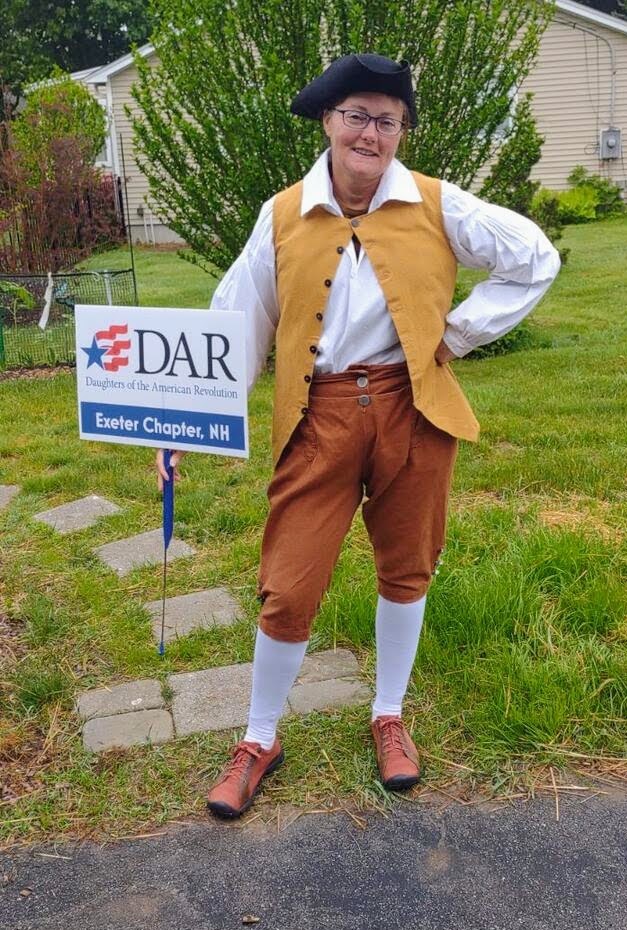
I hope I bump into you at some of the events this year. I might be looking something like this…
With deep gratitude to Mr. Andrews and Mr. Patch. And their wives!!!
Happy Birthday -almost- to the USA! **1776-2026=250** The semiquincentennial approaches. That is a mouthful so let’s just call it the 250th. Its a 2-year long celebration because all the pre-war skirmishes, like the Boston Tea Party and the Battles of Lexington and Bunker Hill, happened before independence was declared. Minutemen were at the ready since 1774. (One of my ancestors, Minuteman Capt. James Patch of Ipswich, MA, fought at Bunker Hill.)
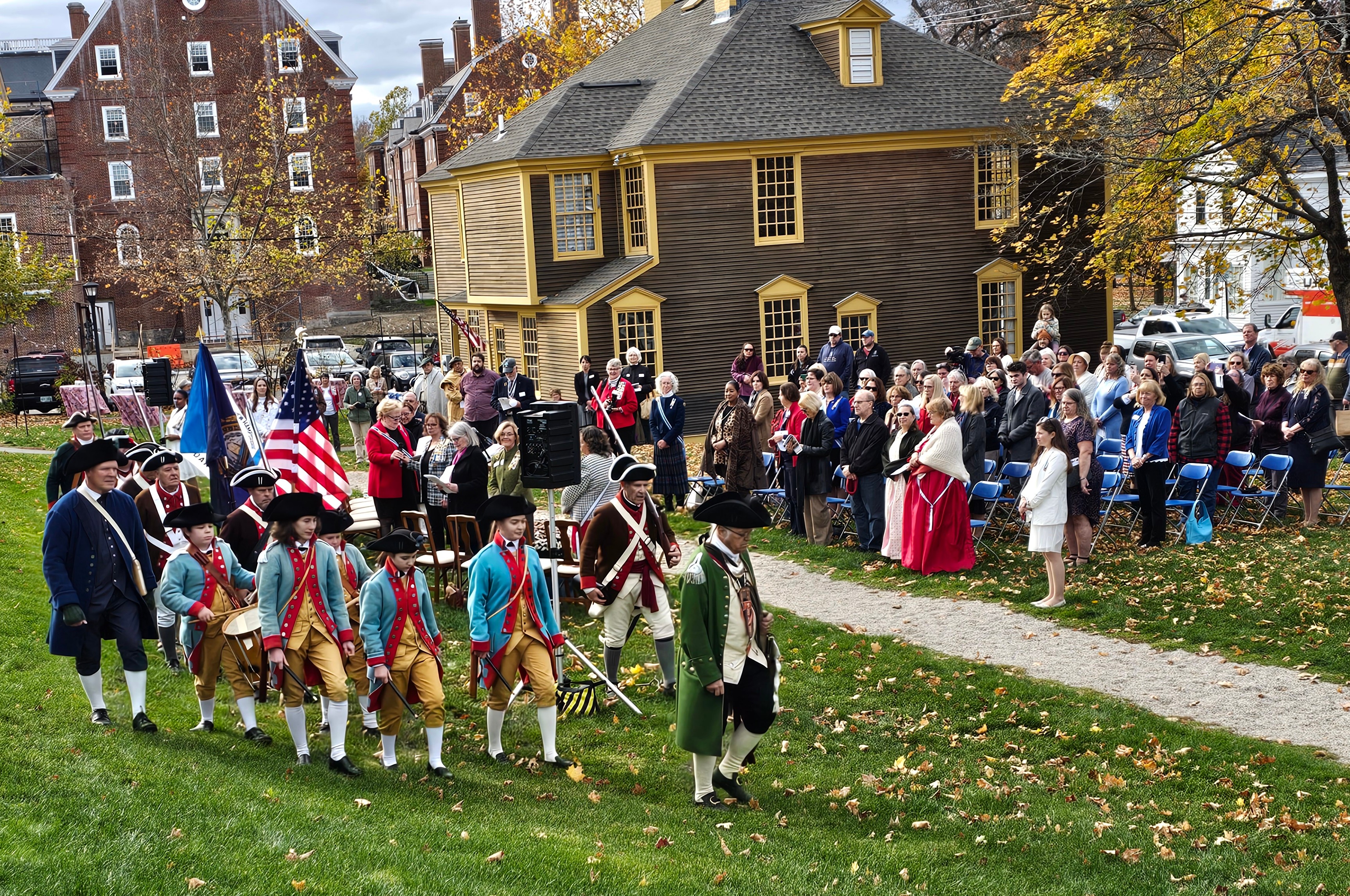
On a cold day in November, 200 people gathered to witness the unveiling of two DAR “America 250!” commemorative signs in Exeter, NH. This was the NH state-wide kick off of the Daughters of the American Revolution celebrations of the 250th anniversary of the founding of America. One standard 250th sign was placed at the American Independence Museum on Water Street. Here’s a picture with some of the DAR women who made the day possible. Many of them are the leaders in their respective chapters from all around the state. The woman in the red blazer is the state DAR leader (regent) who spearheaded the entire project. Huzzah to her!!
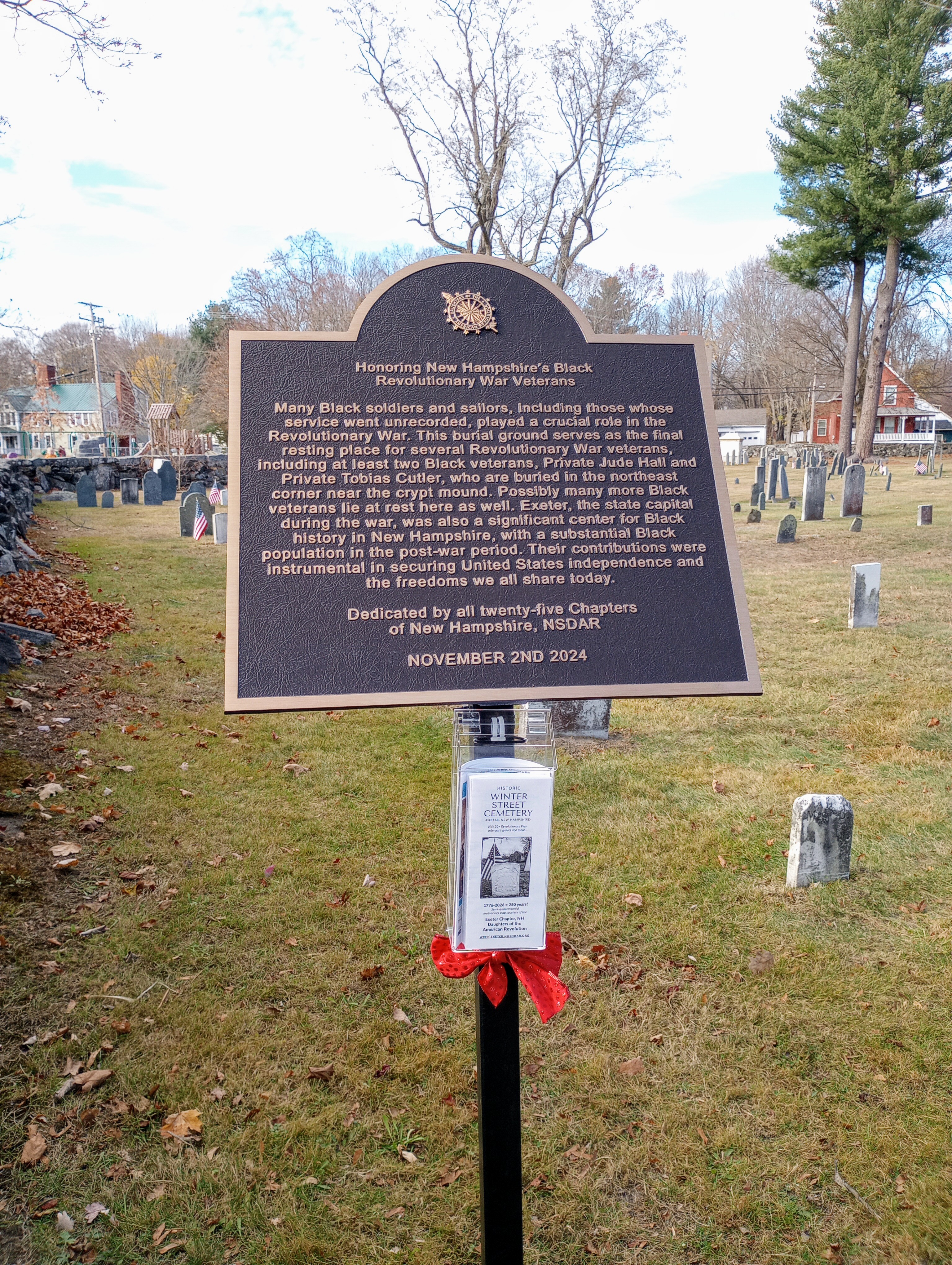
The other sign was placed at the Winter Street Cemetery. This was a custom sign that honored the service and sacrifice of ALL the Black soldiers and sailors from NH. That number is estimated by scholars to be near to 400.
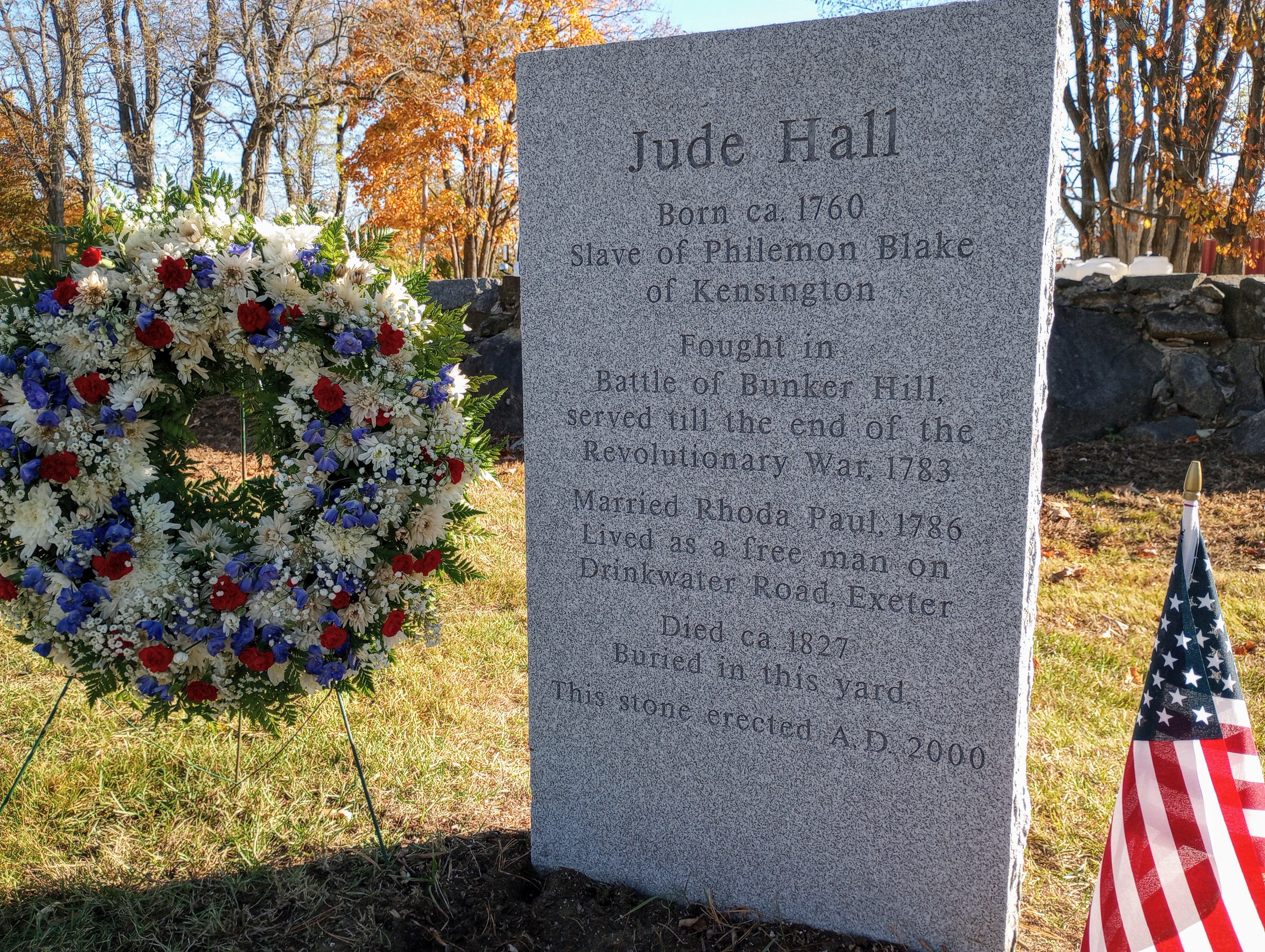
Two Black soldiers, and probably more, are buried there. A gorgeous wreath was laid at the stone for Pvt. Jude Hall by two DAR women in his direct family line who had traveled from afar. It just made my heart sing!
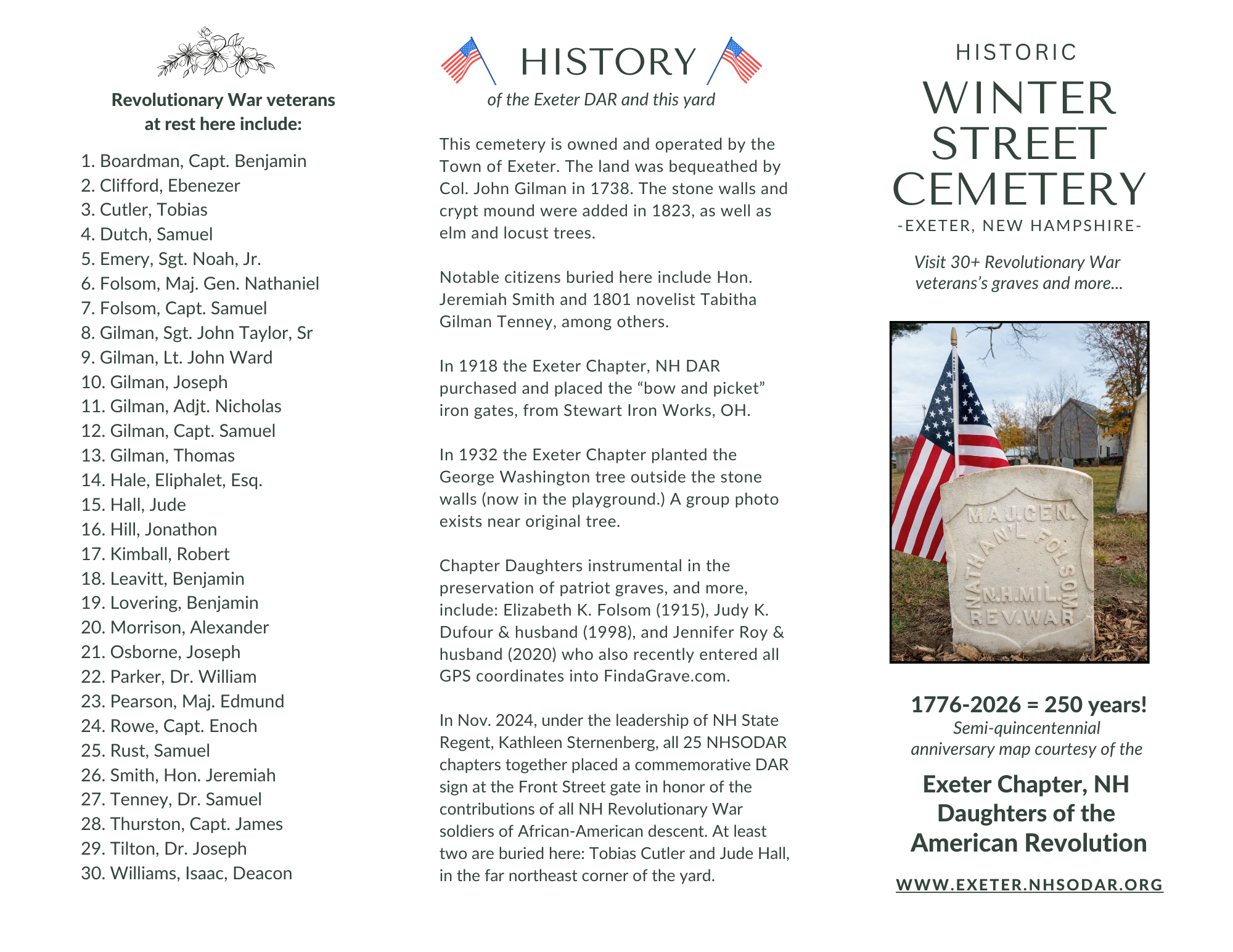
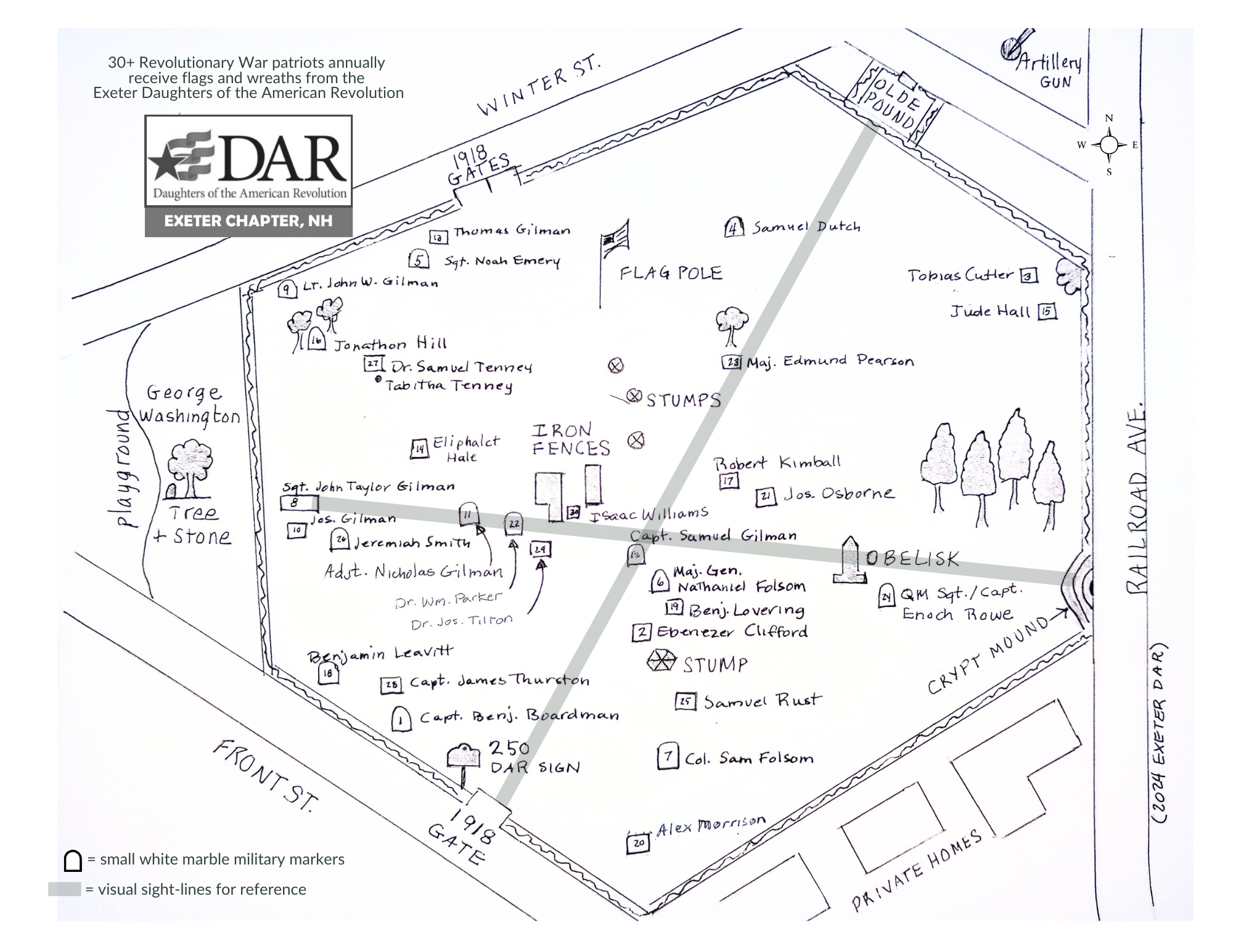
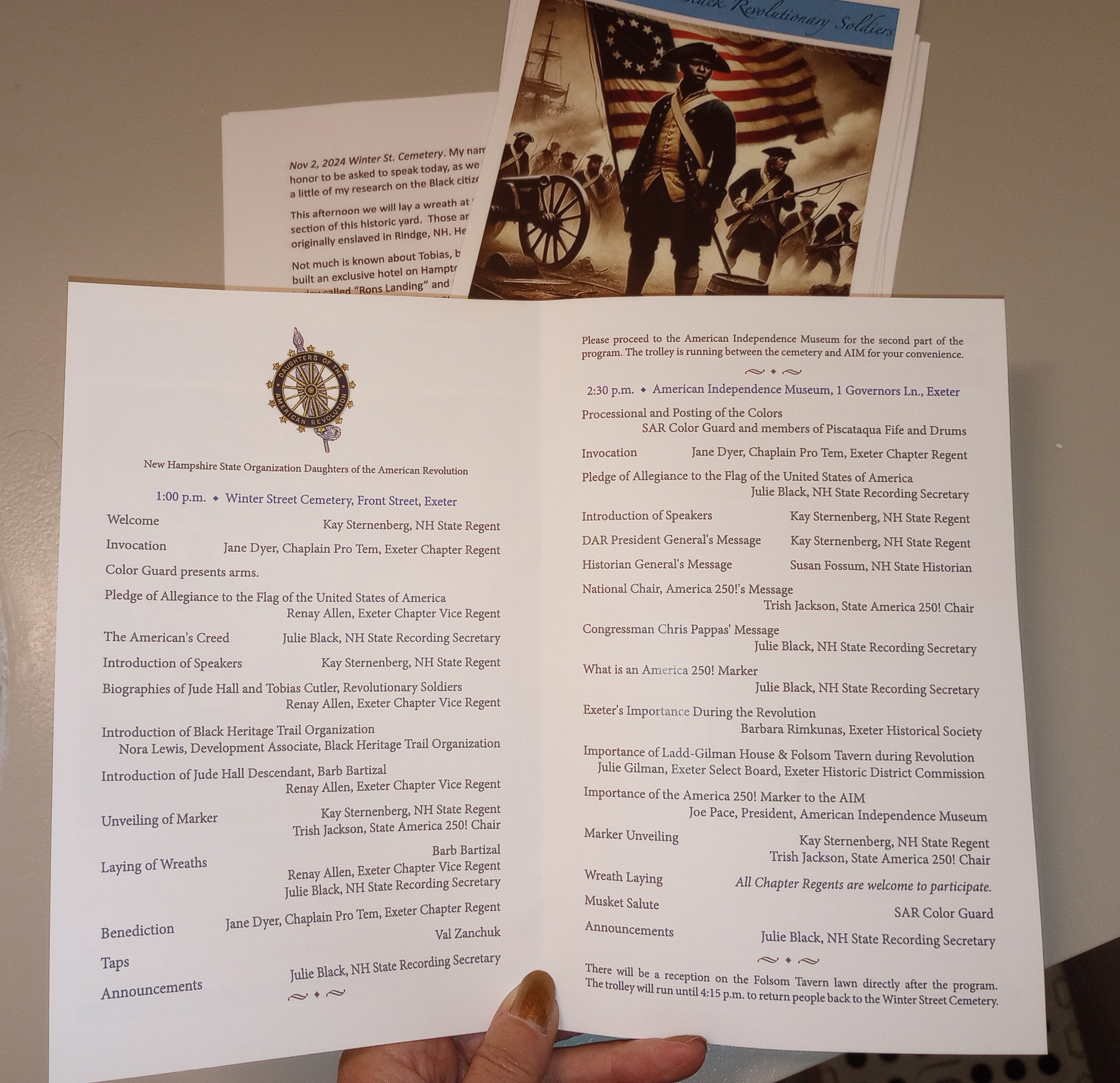
There are 30 Revolutionary War soldiers buried in that olde yard. Here is a map in case you want to visit sometime. And here is the program from that historic day.
Stay tuned for more 250th action in Exeter in the coming years!
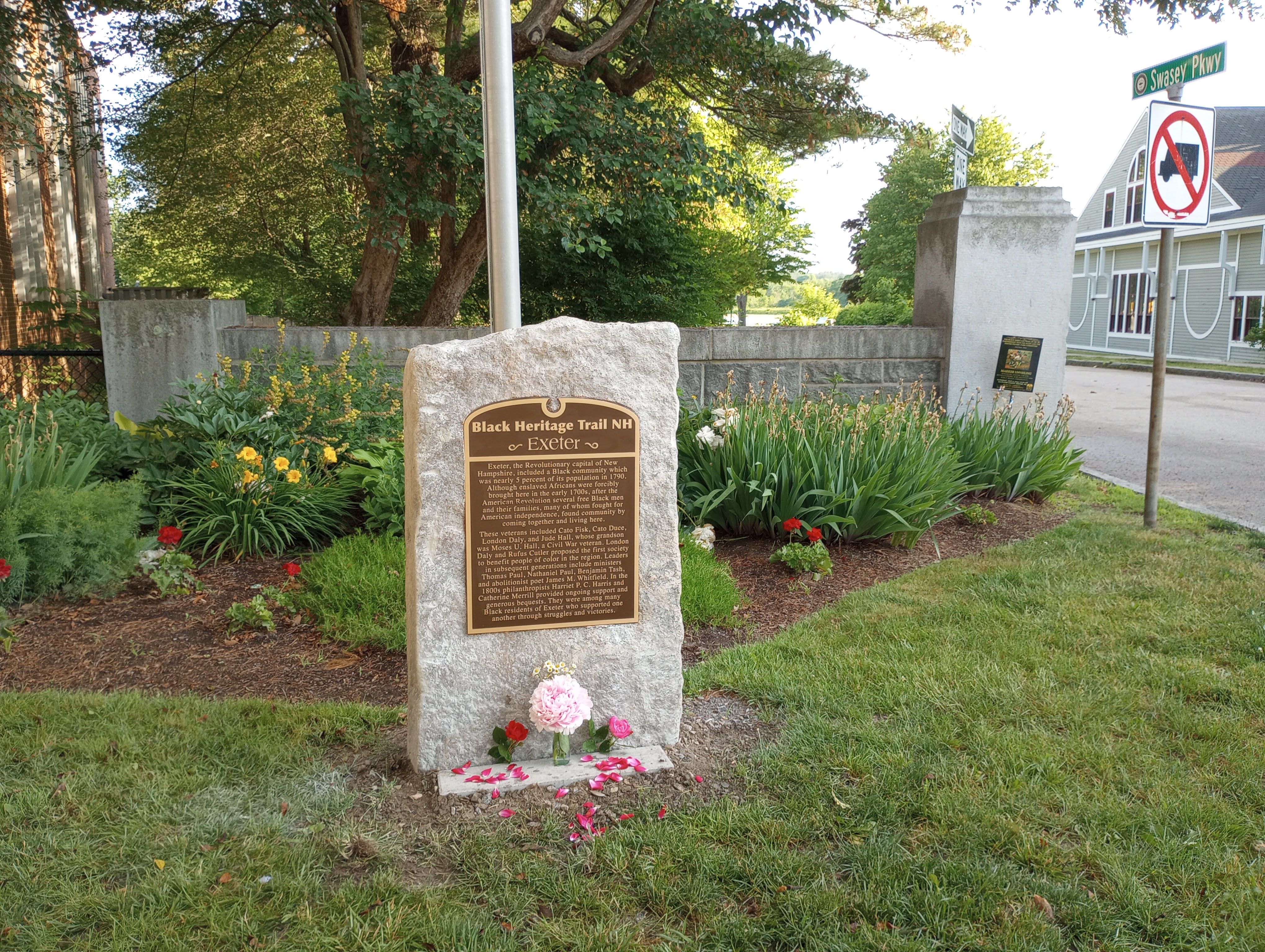
The new Black Heritage Trail of NH (BHTNH) stone marker is finally complete in Exeter. Just in time for Juneteenth this Wednesday!
This BHTNH monument is housed in the new “Exeter’s Black Heritage Pocket-Park” at the corner of Water Street & Swasey Parkway. This park is owned by Exeter Parks & Recreation, with beautiful gardens donated by local resident, Mark Damsell. An ad-hoc group of citizens, “Exeter’s Black Heritage Pocket-Park Committee” worked with public input and selectboard support for nearly four years to bring this park to fruition.
An unveiling ceremony was held on May 4th, 2024. Well over 100 people came to witness and celebrate. Pastry was provided by St. Anthony’s Bakery and Clyde’s Cupcakes. The Folsom Tavern, located directly across the street, held a free open house after the ceremony. Video of this ceremony can be viewed on Exeter TV’s YouTube channel.
The public is invited to bring a cut flower to the monument in honor of Juneteenth. Juneteenth is a holiday celebrated on June 19 to commemorate the emancipation of enslaved people in the US. The holiday was first celebrated in Texas, where on that date in 1865, in the aftermath of the Civil War, enslaved people were declared free under the terms of the 1862 Emancipation Proclamation.
At least two, and probably many more, Black Revolutionary War veterans are buried in the Winter Street Cemetery in Exeter: Jude Hall and Tobias Cutler. (In total, over 30 Revolutionary War veterans – both Black and White – are buried in that yard!)
The NH State Society of the Daughters of the American Revolution, a non-partisan civic service organization of women, has selected Exeter to kick off the statewide 250th anniversary of the USA (1776-2026) celebrations, with a focus on that cemetery.
The NHDAR, along with the Exeter Chapter, will partner with other local groups to host a public ceremony at the Winter Street cemetery to honor all NH Black Revolutionary War soldiers on the afternoon of November 2, 2024 with a post-ceremony reception at the American Independence Museum’s Folsom Tavern. All 25 DAR chapters in New Hampshire have donated to a large historical sign which honors all (nearly 400, according to NH historian Glenn Knoblock’s Strong & Brave Fellows) Black soldiers and sailors from NH that served in the Revolutionary War. Often times, history did not correctly cite the contributions of the Black community. Today’s scholarly research is is helping to correct the omissions.
In fact, in 1790’s Exeter, walking down the street you would have seen that English, Scottish, and West African were the three highest population groups in the community. Many Blacks had businesses downtown, owned homes, and schools were integrated. The Exeter Historical Society has much information on this subject that is available to the public.
The above-mentioned facts are things to ponder as you place your cut flower at the new marker in Exeter. I hope to see HEAPS!! Thanks 🙂
The marker reads:
“Exeter, the Revolutionary capital of New Hampshire, included a Black community which was nearly 5 percent of its population in 1790. Although enslaved Africans were forcibly brought here in the early 1700s, after the American Revolution several free Black men and their families, many of whom had fought for American independence, found community by coming together and living here.
These veterans included Cato Fisk, Cato Duce, London Daly and Jude Hall, whose grandson, Moses U. Hall, was a Civil War veteran. London Daly and Rufus Cutler proposed the first society to benefit people of color in the region. Leaders in subsequent generations include ministers Thomas Paul, Nathaniel Paul, Benjamin Tash, and abolitionist poet James M. Whitfield. In the 1800s, philanthropists Harriet P. C. Harris and Catherine Merrill provided ongoing support and generous bequests. They were among many Black residents of Exeter who supported one another through struggles and victories.”

 RM-Allen.com